
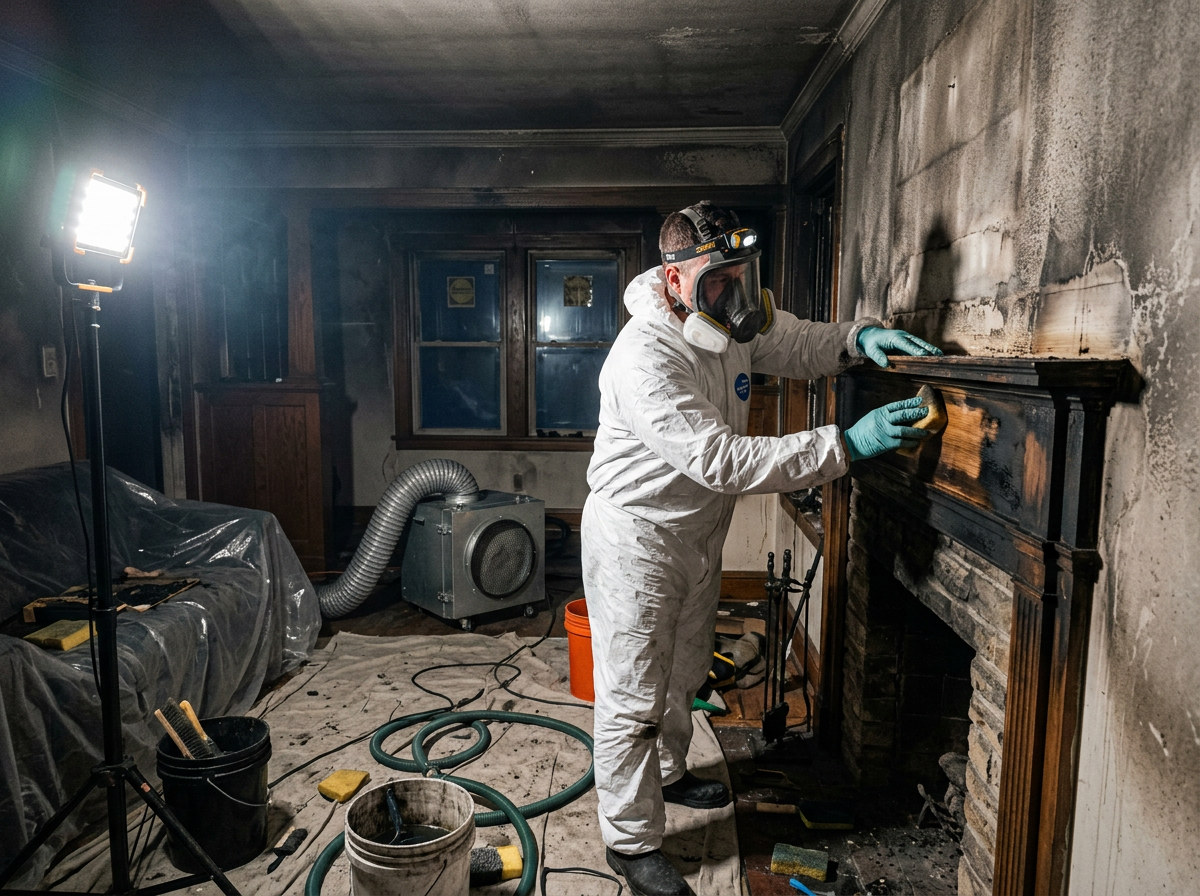
In Michigan homes, especially those built on the 42-inch frost line with finished basements common around Ypsilanti, smoke travels through HVAC returns, laundry chutes, and open floor joists, leaving oily residue on insulation and subflooring that standard cleaning misses. Structure fires here almost always bring Category 2 or 3 water from hoses that mixes with soot to create an acidic slurry; that mixture soaks into porous materials like carpet pad and drywall within hours, forcing removal rather than drying attempts. Winter pipe bursts or heating-related ignitions compound the issue because cold air holds soot longer before it settles, and power outages during lake-effect events leave dehumidifiers offline when they are needed most.
Technicians begin with moisture mapping and soot-type identification because protein soot from kitchens behaves differently than synthetic soot from plastics or wiring. Air movers must be placed to avoid spreading loose particles into unaffected rooms, and negative air machines run continuously until clearance testing. Jobs fail when crews skip the suppression-water extraction step or close walls before meter readings confirm dryness; the clay soils and high water table around Ypsilanti then push residual moisture back into the slab, restarting odor and corrosion problems months later.
Smoke Damage Restoration Near You — Choose Your City
Every city below has its own local Smoke Damage Restoration page with coverage details.
Oakland County
Oakland
Genesee
Macomb County
Macomb
Washtenaw
Genesee County
Ottawa
Wayne
Montcalm
Kent
Kalamazoo
Oceana
Washtenaw County
Ottawa County
Bay County
Bay
Contents pack-out decisions hinge on material porosity and smoke exposure duration, with electronics and textiles often requiring off-site specialized cleaning. Homeowners commonly underestimate how far smoke penetrates behind baseboards and into ductwork in older Ypsilanti stock, leading to repeated odor complaints if those cavities are not addressed during the initial visit.
Technician insight
In Ypsilanti, the thing that catches most people out with Smoke Damage Restoration is how quickly suppression water freezes inside exterior walls during January and February calls, then thaws and carries soot deeper into the slab once heat returns.
Ypsilanti ranch with kitchen fire
Smoke from a cooking fire traveled through the cold-air return into the finished basement. We found acidic water pooled behind the washer standpipe and soot embedded in the carpet pad. Extraction and pad removal were completed the same day, followed by cavity drying and odour treatment; the homeowners returned after two weeks with no recurring smell.
Smoke Damage Restoration Services We Offer
✓Soot and Smoke Residue Cleaning
Surface-by-surface removal of oily and dry soot from walls, ceilings, and contents using pH-adjusted agents matched to soot type.
✓Suppression Water Extraction
Immediate removal of firefighting water from floors and cavities before it migrates into finished basement materials or mixes further with soot.
✓Odour Treatment and Neutralization
Thermal fogging and hydroxyl treatment to reach smoke molecules trapped in insulation, ductwork, and porous wood framing.
✓Contents Pack-Out and Cleaning
Inventory, removal, and off-site cleaning of salvageable household items when on-site methods risk cross-contamination.
✓Structural Drying and Moisture Verification
Targeted drying of affected framing and subfloors followed by meter readings before any wall or ceiling closure.
✓Board-Up and Temporary Protection
Secure openings created by fire crews or inspection access to prevent weather intrusion and further soot migration.
How it works
- 1
Initial Assessment and Soot Classification
Technicians inspect all affected levels, identify soot type, and map water intrusion from suppression efforts.
- 2
Containment and Particle Control
Negative air and physical barriers isolate work zones to keep soot from migrating into clean areas.
- 3
Extraction, Cleaning, and Odour Treatment
Standing water is removed, surfaces cleaned, and odour sources treated throughout cavities and HVAC.
- 4
Drying Verification and Clearance
Moisture meters confirm dryness; final walkthrough ensures no hidden residue remains before reconstruction.
Pricing
Scope is determined by soot penetration depth, volume of suppression water, and number of affected levels; call for an on-site assessment.