
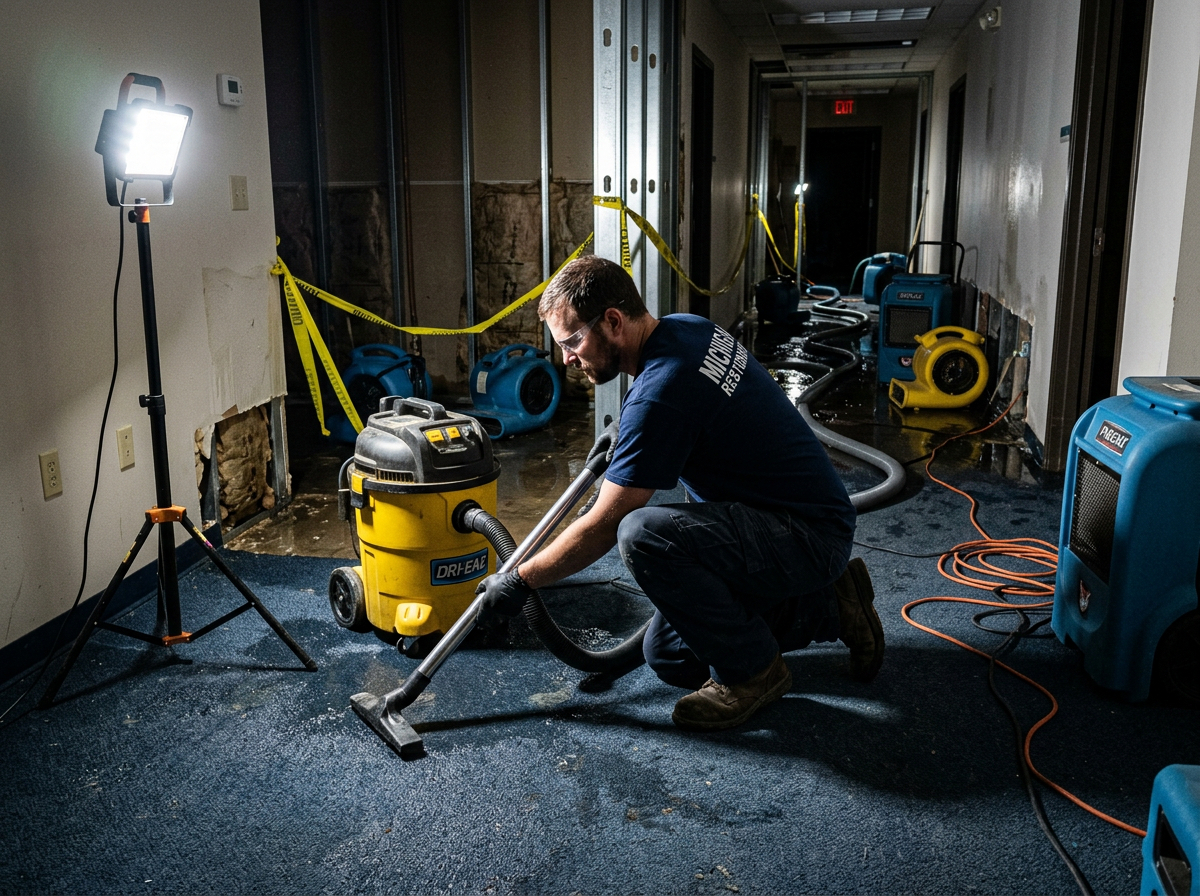
Bloomfield Hills properties feature large estates and post-war homes with finished basements on clay soils that retain water after winter melt or heavy rain. Michigan Flood Response crews travel from Ypsilanti via I-75 and M-1 to reach these addresses directly.
Seasonal patterns tied to the humid continental climate mean work often occurs in late winter through spring, when snowmelt and storms test drainage around Cranbrook and Bloomfield Village.
Here's how our commercial water damage work runs in Bloomfield Hills — the same standards we hold across Michigan, delivered by the crew that covers Oakland.
Commercial Water Damage Services We Offer in Bloomfield Hills
✓Commercial Sewer Backup Response
Handles Category 3 water rising through floor drains in offices and retail spaces, requiring immediate extraction and contaminated material removal.
✓Large-Scale Water Extraction
Rapid removal of standing water from warehouses and multi-tenant buildings using truck-mounted equipment sized for commercial square footage.
✓Structural Drying and Dehumidification
Placement of industrial air movers and dehumidifiers with moisture mapping to dry concrete slabs and wall cavities without reopening finished surfaces.
✓Moisture Mapping and Verification
Daily meter readings and documentation to confirm hidden moisture is eliminated before walls or floors are closed in Michigan commercial stock.
✓Contaminated Material Removal
Disposal of saturated carpet, baseboards, and insulation that cannot be salvaged after sewage or ground water events in Ypsilanti buildings.
✓Post-Event Antimicrobial Treatment
Application of EPA-registered antimicrobials to affected surfaces following extraction to reduce bacterial load from Category 3 water.
Michigan commercial properties face repeated water intrusion from combined sewer systems that surcharge during heavy rain, pushing sewage up through floor drains in Detroit metro buildings. Clay soils around Ypsilanti foundations press water through cracks and cove joints once frost leaves the ground, saturating slab-on-grade warehouses and retail spaces. Technicians must classify water immediately because Category 3 material requires full removal of porous contents and antimicrobial steps from the first hour.
Extraction begins with submersible pumps and truck-mounted units to pull standing water before it migrates into walls or under flooring. Air movers and commercial dehumidifiers are placed in grid patterns mapped by moisture meters, with daily readings logged until drywall and concrete reach acceptable levels. Jobs fail when crews skip verification or leave hidden moisture behind metal stud walls, allowing mold to develop weeks later in climate-controlled offices.
How It Works in Bloomfield Hills
- 1
Site Assessment and Water Classification
Technicians inspect the commercial space, identify water source and category, and document affected areas with moisture meters.
- 2
Extraction and Containment
Standing water is pumped out while containment barriers limit cross-contamination to unaffected sections of the building.
- 3
Drying and Monitoring
Equipment is positioned according to meter data and checked daily until structural materials meet drying standards.
- 4
Verification and Handover
Final moisture readings are recorded and the space is released once hidden moisture is confirmed absent.
Serving All of Bloomfield Hills
We regularly handle commercial water damage jobs near:
- 📍Cranbrook Educational Community
- 📍Cranbrook Art Museum
- 📍Bloomfield Hills Country Club
- 📍Bloomfield Village
- 📍Cranbrook
Commercial Water Damage Pricing in Bloomfield Hills
Scope depends on square footage, water category, and depth of saturation in the commercial structure. Call for an inspection and written scope.
Want the full picture of this service? See our Commercial Water Damage page, or everything we do in Bloomfield Hills, MI.